
by player/coach Jim Langley (also a bicycle aficionado)
Table tennis questions? Email me!
Find a table tennis club
Our Santa Cruz Table Tennis Club
Updated January 2013

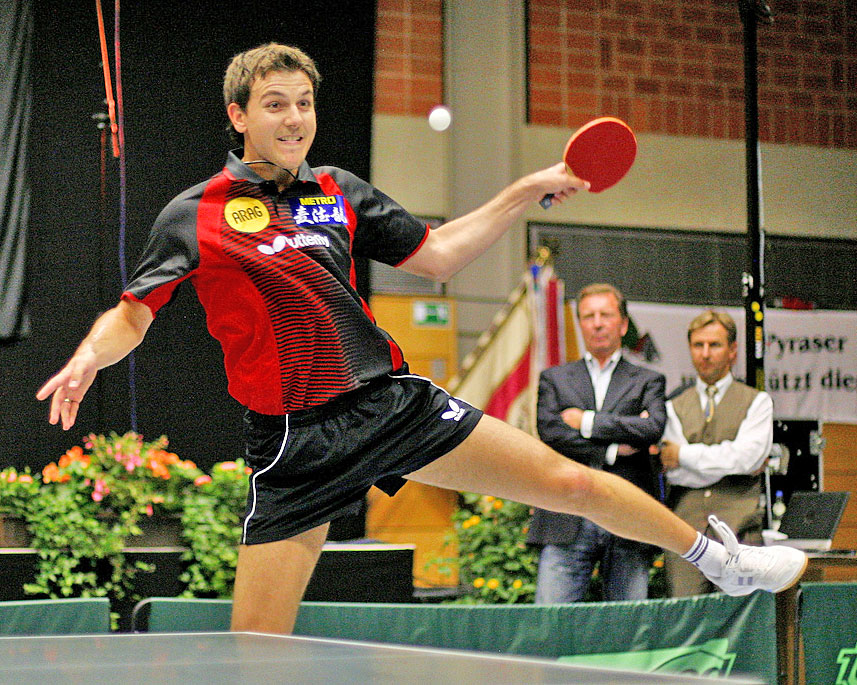
The great Timo Boll
Click to enlarge
I have been addicted to table tennis since childhood, and I enjoy it as much now as then. I’m an intermediate-level player and a club-level coach who plays at the Santa Cruz, California Table Tennis Club. I train and get coached at the World Champions Table Tennis Academy by coaches Stefan Feth, Li Zhen Shi and Zhang Li. This page starts with an article about table tennis that I wrote for a sports magazine. Below it is my coaching advice, a fun rules quiz, links and more. I am always happy to talk about table tennis, so feel free to email me.
The wonderful sport of table tennis
The most popular sport in the world, the one played by more people than any other, is soccer. Everybody knows that, right? (more)
Game, or sport?
About now you may be thinking, “Sure, lots of people have ping-pong tables and play the game, but that’s what it is — a game; not a sport.” (more)
A thinking person’s game
In fact, one of the reasons table tennis is so challenging and fun is that athleticism is just a part of the puzzle. (more)
Everyone’s sport
One of the most appealing things about table tennis is that it’s a game for everyone, and one that has no divisions. (more)
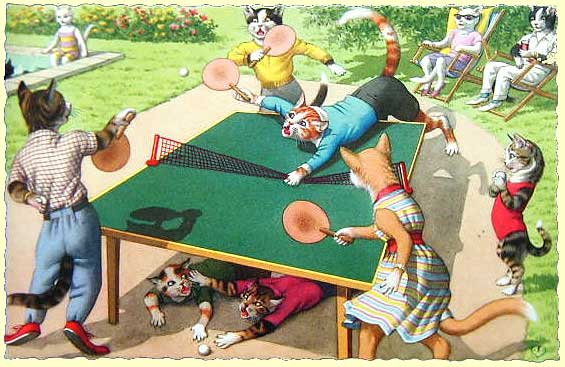
How to get involved
Does table tennis sound like something you’d like to try? Or have you played at home and think you’re pretty good and would like to test yourself out in the real world? (more)
Links
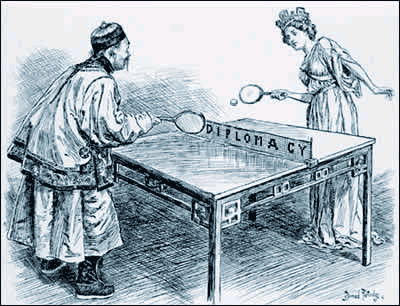
Cartoon by Bernard Partridge, Punch, April 24, 1901
The governing body of table tennis in the United States, where you can find out about tournaments, players, approved equipment and rules.
These sites sell table tennis equipment. There’s a lot available in the way of table tennis paddles, and it can be confusing until you understand, or better, feel the difference. My advice if you’re new to the sport is to start playing at a club, where you’ll be able to try some different paddles and get some advice from people at the club who can watch you play.
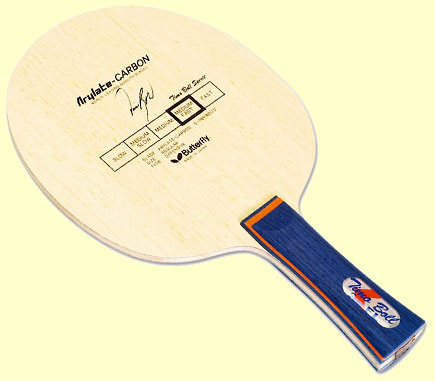
The paddle I use
Click to enlarge
If you’re starting out, purchase a paddle that offers a lot of control. You can find one in the $40 to $80 price range. Get a case for it, too, because the rubber on the paddle deteriorates more quickly when it’s exposed to air and dirt. And be sure to get a box of 3 balls (Nittaku 3-star 40mm in orange).
My current rating is 1823, which means I'm an intermediate-level player. I play an offensive looping game and use the same fast, spinny and expensive equipment used by many professionals with this type of game, a Butterfly Timo Boll Spirit blade with Butterfly Tenergy 05 max thickness rubber on both sides.
Table Tennis Rules Quiz
True or false? (Click on a question to reveal or hide the answer)
- A score of 6 to 0 is a skunk, game over.
- You must serve so that the ball lands in the right box on your side and your opponent’s side of the table.
- If you serve so that the ball bounces twice on your opponent’s side before going off the end or side, you lose the point.
- If you serve twice and hit the net both times, it’s a point for your opponent.
- Paddles with sandpaper on the surface are the best.
- All the great players come from China.
- To decide who serves first, you hit the ball back and forth until someone misses, but it must cross the net at least 3 times, or you have to start again.
- You must win by at least 2 points.
- Your paddle may be as big/small as you want.
- In China, many public parks have cement tables provided
for public play.
Coaching tips for better play
Some pointers on playing better table tennis, which I’ve been taught (but have yet to master) by many great coaches, such as Stefan Feth, Li Zhen Shi, Zhang Li and Nan Li of the amazing World Champions Table Tennis Academy in San Jose, California, where I now train, and past coaches Dennis Davis, Danny Seemiller, Christian Lillieroos, David Rudesill and Masaaki Tajima. Here are some excellent high-level training videos by coach Stefan Feth.
- Table tennis is played more with the body than with the arm and hand. First, move your feet and body until you’re close enough to the ball, then slightly rotate your upper body to make the paddle contact the ball.
- In most cases, especially for developing players, it’s much better to keep your arm and hand and elbow steady, pretty much in the same position and use your upper body, legs and shoulders to move the paddle and contact the ball. This gives you far better control than extending your arm and allowing the joints of the wrist, elbow and hand to move and cause problems.
- The ball weighs next to nothing, and it’s almost always spinning. To deal with this, it is extremely important to be relaxed in your body, arm and hand. You should grip the paddle lightly—just tighly enough to keep it in place in your hand. Even when you want to hit a high ball for a winner, you must remain relaxed like this. Even when you have to run 10 feet across the room to get to the ball, you have to remain relaxed when you contact the ball. It’s one of the important secrets of rapid improvement. Most people are much too tight and hit the ball much too hard. Try to feel the ball actually touch the rubber every single time you contact the ball. Practice bouncing the ball on the paddle, and letting it roll on the surface. Get the feel for the rubber just grazing the ball ever so gently. Breathe in and exhale fully between points to relieve tension and relax your entire body.
- Mistakes are super common in table tennis. Players who improve rapidly forget about mistakes immediately and remain positive, always having fun, trying to play well and looking forward with eager anticipation for the fun of the next ball.
- Good table tennis is not about winning or beating your opponent, or winning points. It’s about executing your game to the best of your ability. Think effort rather than results and give yourself a mental pat on the back after every good try, even if the ball goes sailing into the bleachers and you lose the point spectacularly.
- A good ready position is all important. This should be a neutral position, with your arm in a comfortable and high position in front of the body and with your feet properly placed (right foot slightly back for a right-hander), knees slightly bent, torso leaned forward slightly to create playing space in front of the body for your arm. Also, always try to be on the balls of your feet when in the ready, never on the heels. Now, shift back to the ready position after every serve and every ball. Interestingly, a good ready position is very easy to practice because you essentially just stand in one place like a karate stance, so you can practice it quite easily, and anywhere. It’s also one of the quickest ways for many beginners to improve because every stroke must begin and end in the ready position. If you don’t have an established ready position, you will constantly be starting your shots in a different position, which makes the game far more difficult than it needs to be.
- When it comes to the ready position, one of the most valuable tips I can give you is to keep your playing arm ready to hit the ball. If you watch the best players, you'll see that even in the fastest and most exciting rallies they can keep their arm in a perfect position that lets them get their shot off. If you watch the average club player you'll see something else: the paddle will be down below the table, then it will be high after a shot or maybe the face of the paddle will be angled wrong. That means for every ball, they have to first reposition their arm before they can hit the ball. There isn't time to do this in table tennis and it will cause you to make many mistakes. Instead, you want to learn an optimum arm and paddle position (elbow close to the hip, 90-degree bend at the elbow, paddle to the forehand side slightly and closed to contact the top of the ball), and you want to try to get your playing arm back in this ready position after every shot. If you can do that you will always be prepared to hit a quality shot.
- Always staying in a nice ready position with your arm also in a good ready position is something all top players do so it will really help your game if you can do it. It also makes the game a lot easier to play because you're always ready to hit the ball.
- To improve, you need to practice the strokes and footwork. This takes some help, which you can get by asking at any club. The big mistake is getting into table tennis and always playing matches without training to improve. This is a recipe for playing the same. You may get to the point where you can beat some people who you didn’t beat at first, however, you won’t improve significantly unless you do drills and practice the fundamentals with no match pressure. Playing matches only reinforces mistakes until you develop the correct strokes and footwork and a sound game plan for you.
- If the stroke feels right, it usually is right. All the strokes in table tennis are based on things your body can do naturally and relatively easily. If you’re trying to learn a stroke and it feels uncomfortable or you keep getting injured, you’re doing something wrong. STOP! Get help. Ask someone to watch what you’re doing. In almost every case, simplifying until it feels right will solve the problem. But it’s hard to figure it out yourself, so ask for help.
- Finally, when you watch the better players, you may say to yourself or friends “It looks like they’re not doing anything. It looks so simple.” Tennis great Pete Sampras once said, “People don’t realize how hard it is to make it look so easy.” That excellent quote sums up one of the challenges: the time it takes to learn to play simple, fluid, relaxed table tennis (or tennis). But the important point to keep in mind is something coach Lillieroos told me, which was that the better you play the game, the less you do; all the unnecessary body and arm movements and even emotions or thoughts are eliminated. This makes a lot of sense and helps you focus as you practice and improve. The idea is that as a beginning player you do a lot of unnecessary things, which you can see if you watch the wild strokes and unusual footwork and body positions of entry-level players. If you learn the right strokes and footwork, however, and you work on them enough, you begin to do everything more simply, with one ready position, one forehand and backhand counter, push, loop and so on, with all your strokes. Your game and shots and footwork become very refined; you essentially repeat basic things that you’re trying to perfect over and over, and gradually you get very good at them so that they look very easy because you’ve repeated the same thing thousands and thousands of times. This is a powerful concept, because those people who are always varying their strokes, footwork and body positions aren’t repeating anything, aren't “grooving” their games, so they will improve very slowly if at all. If you want to play table tennis better you need to figure out (with the help of a coach or better player) what you need to work on, develop a good game and then practice basic things and your basic game strategies until you’re very good at them. Notice I said “basic” things — good strokes and good table tennis is not complicated or advanced. It’s within reach of anyone who does the right things and sticks with it. If it seems to you like table tennis is a complicated, difficult sport, that’s a sure sign that you will benefit from some good coaching.
- Here are some proven simple strategies to control your matches and improve your chances of winning:
- Serve as short on the table as possible, then place the next ball as deep as possible (this forces your opponent to move in and out quickly, one of the most difficult things to do).
- Keep placing the ball to your opponent’s elbow (this forces them to move to the side in order to hit the ball).
- Place the ball all over the table, to discover if your opponent has a weak spot where they have trouble getting to or stroking the ball (then hit to that spot repeatedly).
- Change the spin on the ball to surprise your opponent and make them hit it into the net or pop it off the end.
- Change the pace of the ball from slow to fast, to surprise your opponent into making a mistake.
I hope these tips help you reach your goals!
— Jim
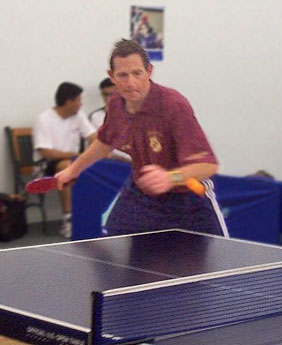
Here I am forehand looping (the main offensive weapon today) a few years ago in a tournament in Fairfield, California. I've now shortened my forehand loop (notice that the arm is almost fully extended here). By keeping more bend in the elbow, dropping the right shoulder and bending the right leg more, it gets much easier to contact a fast ball and generate more power/spin from the larger muscles in the upper and lower body. You can also see that my grip is slightly wrong and that the top of the paddle needs to be more down, toward the floor.
These minor changes have improved my footwork, because by focusing on a tighter upper-body position you bend your knees more and drop the shoulder more, which brings the feet more into each loop. And, when the feet are right, you move to the next ball more easily and naturally.
