

Bike racing in the 20s was big time, a real gas, and 99-year-old Alf Goullet remembers
by Scott Martin
(first published in Bicycling Magazine, May 1990)
THE ADDRESS IN MY NOTEBOOK SAYS MADISON AVENUE, so naturally I’m expecting tall buildings full of guys and dolls in swanky duds, the type who make plenty of cash money telling muggolas like you and me what kind of hair tonic to buy.
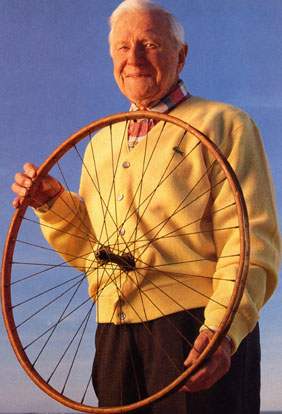
Show him a wooden rim and a
track bike from the early 1900s,
and Goullie’s eyes will sparkle
like a rock on a dame’s pinkie.
Photo by Zickl + Butcher
(mouse over to see Alf back then)
But when I take a gander along the street, I’m eyeballing not swells but citizens who appear to carry very few potatoes in their pockets indeed. In fact, the store windows have more bars on them than Sing Sing, and gangs of kiddies just out of short pants roam the sidewalks looking for suckers such as yours truly who are all begging to be punched in the kisser and relieved of their do-re-mi.
Although my boss frequently claims I do not possess the brains God gave geese, I quickly comprehend that this Madison Avenue does not lead to its famous namesake on Manhattan Island, even though I am no more than 20 miles away in a burg called Irvington, just outside Newark.
What brings me to Irvington is a tip that buried treasure lies here, and what scribe can resist such rumors, particularly one who has a column to fill in tomorrow’s paper, not to mention an editor who gets more than somewhat peevish when said columns do not materialize. This alleged treasure does not consist of mounds of doubloons or even stacks of C-notes, but is said to be worth much more than such baubles, although personally I cannot imagine anything more valuable than fresh scratch.
What’s hidden in Irvington are some of the last remnants of a time when the bike racing game was so big it made football and baseball look like tiddlywinks. I’m talking about the 1920s, when Prohibition, flappers, jazz and other such nonsense reigned over the U.S. of A. Every week, gangsters, millionaires, movie stars, and thousands of ordinary Joes flocked to velodromes to cheer those “Stars Of The Saucer,” as the headline writers billed them. Bike jockeys the world over gathered here, for racing in America was hotter than a stove and American riders were the ones to beat.
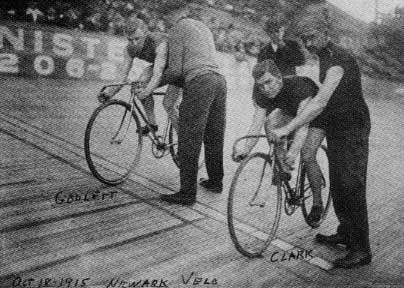
Goullet (top) raced against all the hotshots, including top pro Jackie Clark, at the Newark Velodrome.
It was a wild and wonderful time that couldn’t last, and of course it didn’t. Nowadays most of the people who lived through it have long since kicked the bucket, though there are still a few around to tell young whippersnappers like us what happened.
But like the filly that cost me a double sawbuck in the third at Belmont yesterday, I am getting ahead of myself.
Over No. 39 Madison Avenue a sign says, “Brennan’s” in peeling red paint, while behind the window some bicycles and their parts wait for someone to take them home. The bike shop looks closed, but the door yields to a push and I peek inside, which is the signal for a jumbo-size mutt to commence barking and trying to snap the little leash that is keeping him from ripping my throat out.
The leash holds, so I enter and shake hands with the Brennan brothers, Jack and Bill. Although a plucky kerosene heater burns in the rear work area, both men wear caps and layers of flannel shirts and sweaters on this raw day, which is fit for neither man nor bookie.

Bill and Jack’s old man, Pop Brennan, was a race mechanic in them days, and today his shop is a museum of sorts.
Photo by Zickl + Butcher.
Bill, the quiet one, is the baby brother, just 70 years old. Jack, who turns 75 in May, is the talker. Their old man, “Pop” Brennan, toiled for years as chief mechanic at track races throughout the country in addition to running this shop, which stands just a few blocks from the site of the old Newark Velodrome. Pop’s boys grew up in the business and eventually stored many souvenirs from that era in their shop.
“Let me show you the best tool in the place,” says Jack as we get acquainted over a cup of java. Expecting to see some delectable antique wrench, I watch as he opens a drawer under the old workbench, pulls out something wrapped in white cloth, and produces a very modern .38-caliber revolver. Despite never having packed a rod, I see this is the real McCoy and immediately concur that it is indeed a fine tool.
After we chew the rag awhile, Jack leads me to the adjoining showroom where some Schwinns sit patiently in the dark. From a dusty shelf we pull down half a dozen cardboard boxes full of scrapbooks with cracked leather covers of red and black and green. Glued to the books’ yellowed, crumbling pages are hundreds of newspaper clippings, programs, and sundry mementos from the days when bike racing was more popular than bathtub gin, or at least gave this homemade libation a run for its money.
One racer whose name keeps appearing in the clips is Alf Goullet, dubbed the “Australian Bullet” since he hailed from Down Under and was known to pedal his machine as fast as said projectile. Jack says “Goullie” is still alive and kicking in Red Bank, a Jersey-shore burg about 30 miles from Brennan’s. What better way to get the inside dope on this bike-racing dodge than to hear it straight from the horse’s mouth?
So I hightail it to Red Bank to meet Goullet (rhymes with roulette), who turned 99 in April. A fit, white-haired gent who looks 65 opens the door, and I’m about to ask if his father is home when I comprehend that this is Alf himself. Dressed in gray slacks and a blue blazer, he is livelier than a spring chicken. His high-class Limey accent sounds grand, and his blue eyes sparkle like a rock on a dame’s pinkie. In fact, it’s a good thing I caught him at home, for he is about to hop a plane to visit his ever-loving daughter in California.
Observing how parched I appear, Goullet pours two glasses of suds and proceeds to describe the bike racket. He is gracious and friendly, the kind of guy with class written all over him, unlike the palookas with whom I often deal. It’s a cinch that I am jawing not just with a man who was a great athlete, but one who was a great sportsman, too.
Even these days, though, Goullet is no slouch in the competitiveness department, as he still gets agitated when discussing races 70 years ago that he could have won except for some rattle-headed move by a teammate. But then he asks me not to use the racers’ name for fear of insulting the fellow, even though said rider has been pushing up daisies for many years.
“Alf is a very high-class fellow — a gentleman, always well groomed, well spoken, a credit to the game,” recalls Normal Hill, 84, a former racer whose career briefly overlapped Goullet’s. “He was always a very friendly, democratic sort of fellow. Not that he was snobbish or anything like that, but he knew all the right people and traveled in the right groups.”
Though he was a star who hobnobbed with the swells, Goullet could be a big-hearted lug, too. For example, when he discovered that a kids’ baseball team in Newark was calling itself Goullet’s All-Stars, he secured seats for them at the velodrome, even though the promoter blew a gasket over the gratis tickets.
Goullet has had little formal education, but he could have written the book on charm and earnestness, as a Salt Lake City reporter learned during a 1912 interview. “Alfred Goullet, sensation of the cycle racing world, declares that the women of Salt Lake are the most beautiful he has ever seen,” the scribe wrote. “He is not quite 21 years old and is one of the cleanest, most straightforward and likable athletes who ever appeared here. But Goullet is not a woman’s man. He likes to admire from a distance. In fact, he does not allow any counter attractions to interfere with his determination to become the cycle racing champion of the world.”
Born in 1891, Goullet grew up in Emu, a wide spot in the road about 150 miles north of Melbourne. As a youngster he made his own bike track by having a horse drag a log to clear away the grass. He started racing and soon notched more wins than Australia has kangaroos. A U.S. promoter names John M. Chapman got wind of Goullet, and the 19-year-old Aussie inked a contract to go stateside and race big time.
Goullet arrived at New York Harbor in the winter of 1910 “in a snowstorm, wearing a sleeveless shirt and a straw hat because it was summer at home,” he says. His clothes got damp, but he was wettest behind the ears. It didn’t take him long to dry out and wise up.
Goullet joined the velodrome circuit, which eventually included 8 races a week for 7 months of the year. The riders might race on Sunday afternoon at the Newark Velodrome, Sunday night at the New York Velodrome, Monday in Providence or Boston, Tuesday back in New York, Wednesday back in Newark, Thursday in Philadelphia, Friday in New York again, and Saturday in Newark again. There were also tracks in Chicago, Salt Lake City, and elsewhere.
Fields of 50-60 professional riders competed in the open events, and a typical program included races from 1/4 to 5 miles. When sprinting, these speedsters could hit 40 mph on their 18-pound fixed-gear bikes, complete with steel components and wooden rims.
Admission at Newark cost a quarter, and crowds of 12,000 or more were common. “You have to bear in mind that this was a time when mass communication was not developed as it is today,” says Peter Nye, who penned Hearts of Lions, a sorely needed book on the history of American bike racing. “The public expected to see their heroes in the flesh, not as reconstituted dots on a screen, like today. Bicycle racing was live entertainment.”
In fact, you might say it was larger than life, what with characters like Reggie “Old Ironman” McNamara, who once deposited a tooth in the wooden track during one crash. Another rider was killed in a spill when a splinter pierced his abdomen.
“I get a kick out these guys playing basketball and tennis today,” says Jack Brennan. “If they get a hangnail, they stop. Not the bike game — once McNamara crashed and broke a rib, but he finished the race.”
It wasn’t just the racers who provided the drama, though. Promoter Floyd MacFarland played a key role in the sport until he was killed when somebody plunged a screwdriver into his skull during an argument over velodrome advertising. “The screwdriver caught Mac behind the ear and penetrated eight inches into his brain,” Goullet recalls.
The event that truly drove the citizens bananas was the 6-day race, in which as many as 16 two-man teams would compete on a velodrome nonstop for 6 days. It was a diabolical event requiring incredible endurance, lung-scorching bursts of speed, mind-numbing discipline, and not a little showmanship. Nobody was better at it than Goullet.
Picture this: It’s almost 11 o’clock on Saturday night at the Garden (which any mug knows means Madison Square Garden in New York City — the 6-day mecca). The joint is packed with guys in fedoras and snazzy suits, and dolls in slinky skirts and cloche hats that look like fancy helmets.

The Garden was a 6-day mecca. Every Saturday night the joint would be packed with guys in fedoras
and dolls in slinky skirts.
(click on photo to see another six-day race)
Some of the daffier citizens lean over the rail, screaming and waving hundred-dollar bills at the riders, who flash by in an all-out sprint. Naturally, many of the era’s celebrities are out in force, from crooner Bing Crosby to heavyweight boxing champ Jack Dempsey. Newspaper reporters from the dailies watch the action with hard, keen eyes, and nightclub entertainers drop in to play a few numbers for the crowd during lulls in the action.
“I’ve heard of times in the Garden when people would slip the fireman ten bucks to let ’em sit in the aisles,” says ex-racer Hill. “Also, if the ushers in the Garden saw somebody leave a box seat, they might say to someone way up in back, ‘I can sit you in front.’ Naturally the usher expected a couple of bucks. The story was that if an usher couldn’t make a thousand bucks during the week, it was a bad week.”
Anything could happen during a 6-day, as shown by an old newspaper story about a race at which a spectator named Keyes had a beef with another fan and proceeded to shoot him. It seems both shooter and shootee had been wetting their whistles more than somewhat. “A riot ensued immediately,” the article said, “spectators running on the track, while those in the vicinity of the shooting stampeded when the adherents of Keyes rallied to aid him in his attempt to resist arrest by the police. It did not lead the racers to relax their speed.”
Indeed, the only real break for the racers comes early each morning when one teammate staggers to the downstairs training quarters to grab 2 or 3 hours of shuteye while his groggy partner circles the track. Trainers massage the weary rider, who then inhales such nutritional delicacies as steak and mushrooms, chicken on toast and, if he’s suffering from a sore throat, a fine concoction of 2 raw eggs well shaken in sherry wine. It’s said that a few racers’ diets also include some illicit dessert such as cocaine and strychnine to help keep them going.
The rule that one rider must be on the track at all times is strictly enforced, as evidenced by the $25 fine levied against any racer who takes a bathroom break. But when the action heats up during the afternoon and evening, both men must be available to contest crucial point sprints and guard against attacks by other teams trying to lap the field, and thus, take the lead.
“Riders have told me of being jerked from their cots and riding through a jam and then returning to sleep with no memory of having been awakened,” Goullet wrote in a ’26 Saturday Evening Post story about 6-day racing. “They were like the soldiers in the World War who fell asleep while marching.”
Goullet performed heroically in many epic 6-day wars. In ’14, he and teammate Alfred Grenda set a world 6-day distance record by logging 2,759 miles and one lap. This mark, almost equivalent to riding cross-country, still stands today. Near the end of another 6-day, Goullet’s partner crashed and had to withdraw, leaving Alf to ride alone against the other teams for the last 22 miles. He held on to win, natch. And in a ’23 6-day at the Garden, Goullet and Grenda won by lapping the field at 10:59 p.m. on Saturday, one minute before the race ended.
Goullet’s prowess earned him a trip back to Australia in ’11, where he won 6-days in Melbourne and Sydney. He also took first in a Paris 6-day in ’13, besting a field that included 2 Tour de France winners. Overall, Goullet won more than 400 professional races on 3 continents, including 12 official 6-days. He also set a hatful of world records, among them a 50-mile time of 1 hour 49 minutes, which stood for 50 years.
Blond, muscular and handsome, Goullet cut a dashing figure on the track, often garbed in his trademark scarlet silk jersey with black-trimmed sleeves. He once estimated that he earned $100,000 in the bike game, a pretty penny considering a working stiff made $5 a day, a beer cost a dime, and rent ran about $25 a month.
“Goullet was the best in the ’20s,” says Jack Brennan. “He was the best all-round of his time.”
The newly married Australian Bullet hung up his cleats in ’25, going on to own and operate a skating rink and work in the insurance business. Today Goullet’s tidy apartment contains only a few reminders of his bike-racing past, including a plaque on the wall commemorating his induction into the U.S. Bicycling Hall of Fame. He is also in the halls of the Australian Sports Federation and Madison Square Garden.
“I don’t think back much,” he says. “That was it. That’s the best I could do.”
Goullet quit the bike game at the right time, for it soon got the old heave-ho. Shortsighted, greedy promoters began bleeding the sport. Then World War II came along, followed by automobile-mania, suburbia, and televised football and baseball. People figured only a sap would want to hop a trolley into the city and pay to watch grown men ride bicycles. You didn’t have to be smarter than 3 Philadelphia lawyers to know the jig was up.
Once the cheering stopped, the velodromes crumbled, the racers died off, the newspaper clippings yellowed, and memories faded. Now all that’s left are the recollections of the few old-timers and some dusty scrapbooks in joints like Brennan’s.
I am not one to bust a gut over something that does not involve personal financial losses of the equine variety, so whilst departing No. 93 Madison Avenue I realize there must be an object lodged in my eye, for a tear has fallen on my notebook.

to the SPIN page