

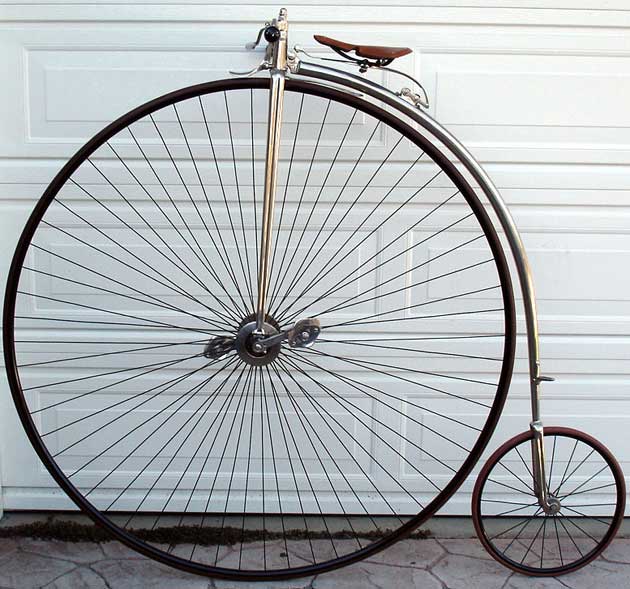
Rest your mouse on the picture to view an original 1885 ad for the Singer British Challenge
In the heyday of highwheel bicycles, also known as “ordinaries” or “high bicycles,” the Coventry Machinists’ Company in Coventry, England, was one of the most-innovative and largest manufacturers in the world. It was this famous company once led by the engineering genius James Starley, inventor of tangential spoking (crossed spokes), that manufactured this 1885 Singer British Challenge highwheel.
I bought this bike from a fellow collector because I wanted a nearly original highwheel. This machine has matching serial numbers on every key component, almost all original major and small parts and an impressive array of beautiful and high-tech details. For example, the elegant backbone is ovalized and tapered while the front and rear forks are fluted (creased) for strength and beauty.
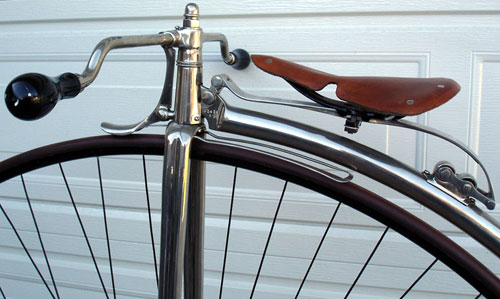
Also, in the photo above, notice how the pan-style saddle floats above the backbone on a leaf-spring-like flat-steel bar floating on rubber-bushing-loaded pivots. The loop of wire between the backbone and tire is a pants protector that moves as you turn the wheel to steer and ensures that the tire, which would have been caked with mud, or worse, on the non-paved roads of the 1880s, doesn’t soil your knickers. (We collectors dress in original period costumes when riding these time machines.)
Below, you can see that the radially laced spokes thread into the hub, a common treatment on highwheels. Barely visible is the special bearing arrangement. Singer included double bearings on the front hub (two sets on each side), another example of the top-quality materials and craftsmanship used on these incredible keepsakes. In fact, the machinists I’ve worked with when restoring my two high bicycles have been amazed at the designs and exacting tolerances.
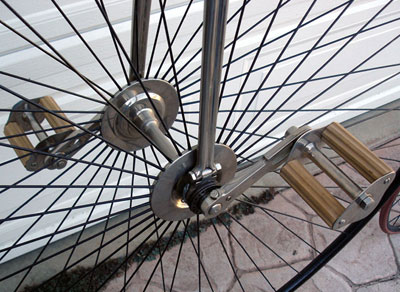 When I acquired this bike, all the parts were there; however, the full-nickel finish had begun to rust, which is why I had to have it re-nickeled. It looks like chrome because it’s so new. Over time, even if I baby it, it will develop a yellowish tint giving it a nice aged patina.
Many hours went into refurbishing the pedals, too. Here, I enlisted the help of a master metalworker who painstakingly reshaped the end plates and centers, and silver-solder-filled the many holes caused by rust pitting.
Rust remains a problem. It has severely undercut the spokes at the rim and they need to be replaced to make the bike rideable; however, to replace the spokes would ruin some of the originality of the bike, so it’s analysis paralysis deciding whether to keep this beauty as original as possible or cut the old spokes out (the only way to remove them because they will not fit through the rim holes) and rebuild the wheel with new spokes.
One-hundred-and-twenty-five-year-old antiques corrode, and that’s what happened to the original seat. The replacement is as identical to the original as I could make it, though the 1885 version would have surely had a more finished and professional appearance probably with some hand tooling.
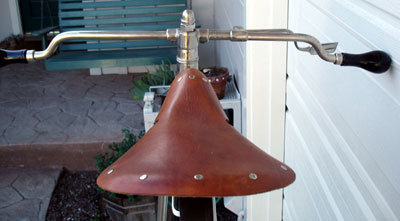 This view (photo) is what you see when you mount the bike. For this there’s a peg you step on visible in the photo atop this page. You rest your left foot on the peg, hold onto the handlebars, push along with your right foot until the bicycle picks up enough speed to balance. Then you push with the leg on the step to boost yourself up onto the seat, and off you go. To dismount, you reverse the steps or simply vault sideways and onto the ground.
Riding a highwheel is unlike pedaling any other two-wheeler. The huge wheel doesn’t drop into holes and ruts so the ride is wonderfully smooth. With no chain, cogs or freewheel, pedaling is whisper quiet, too. And, of course, sitting so high, you can see forever. It’s no wonder that from about 1879 to 1889, these magnificent beauties were kings of the road.
Specifications
Size: 56-inch (the size of the front wheel; the taller you are, the larger the wheel)
Rear wheel size: 18-inch diameter (including tire)
Spokes: 60 front; 20 rear; double-butted; headed at the rim; threaded at the hub
Weight: Approximately 60 pounds
Tires: Almost solid rubber; held on by very tight wires running through the tire centers
Longest ride: Actually, I don’t ride this one, but I have ridden over 100 miles
