THE
TIME MACHINE, H. G. Wells’s famous science-fiction novel, appeared
in 1895. In it, people travel through time in a capsule that “lands”
whenever you want. It’s an intriguing concept that has spawned books,
movies and TV shows with the theme. Yet, here we are, over a century later,
no closer to Wells’s vision than when he penned his novel. Right?
Wrong. Plenty of people have machines onto which they hop to roll back
time. And I’m one of them. What’s the gimmick? An antique bicycle;
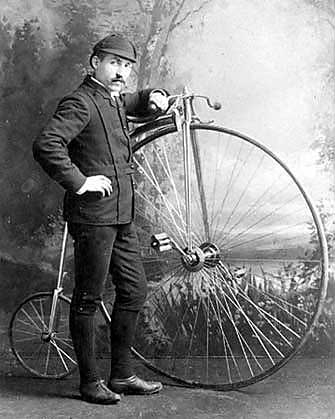
more specifically, a highwheel bicycle, sometimes called a penny-farthing.
In its heyday from the 1870s to 1880s, this bike ruled the world’s
mostly deserted roads (no cars back then—just horses and wagons),
becoming so popular in fact, that it was also dubbed the Ordinary.
Rolling in the years
The bikes are anything
but ordinary, though. In fact, today they appear unrideable with their
enormous front wheel, tiny trailing wheel and seat perching the rider
seven feet in the air. But mount one of these relics (originals are super
rare, highly sought after and valuable), touch the nickel-plated moustache
handlebars, sink into the long saddle-like leather seat, get that enormous
wheel rolling and you feel at one with bikers of old. Like touching a
thousand-year-old redwood, you’re hard-wired to the past, transported
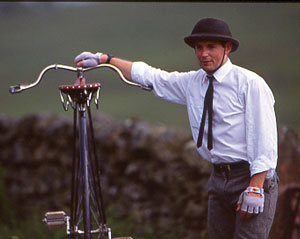
to a simpler time and place. To complete the illusion, vintage cycle enthusiasts
wear knickers and knee socks, gauntlet gloves and jaunty caps or pith
helmets just like our predecessors.
We also ride as a group the same way cyclists did it way back when. Vintage
cycling events take place around the globe. I’ve been to a few. My
favorite was the KM150, held in Scotland in 1990 to celebrate the 150th
anniversary of Kirkpatrick Macmillan (KM150, get it?) who the Scots believe
invented the first pedal-power bike in 1840. I figured it’d be perfect
for me, seeing that I’m part Scot. It turned out to be quite an experience
and might give you a feel for how this have-old-bike/travel-through-time
thing works.
One big box
 I had three
hurdles to clear to make that flight to Glasgow: restoring my recently-acquired
1886 Victor Light Roadster (cost: $2,000) that was seriously hobbled by
old age; learning to ride it; and finding a way to transport the monstrous
machine to Scotland. Calling fellow wheelmen on the trip, I learned that
I could put the bike in a homemade cardboard box and take it so long as
the plane was a 747.
I had three
hurdles to clear to make that flight to Glasgow: restoring my recently-acquired
1886 Victor Light Roadster (cost: $2,000) that was seriously hobbled by
old age; learning to ride it; and finding a way to transport the monstrous
machine to Scotland. Calling fellow wheelmen on the trip, I learned that
I could put the bike in a homemade cardboard box and take it so long as
the plane was a 747.
Refurbishing the bike in time was more difficult. Long-obsolete parts
were hand made by a machinist (such as exact-copies of the original pedals;
thanks Jim Spillane of Victory
Bicycles!).
I rebuilt
the 56-inch-diameter front wheel—a month-long ordeal because the
original spokes, which I reused, had rusted into the nipples. The seat
and all its hardware had to be built from scratch because they were missing.
The bike needed painting. A complicated tool had to be fabricated to install
the nearly solid-rubber tires that are held on with a tensioned silver-soldered
wire.
When it was done, standing back looking at the gloss-black iron horse,
I felt like I’d saved a piece of history, and I knew there was no
way I’d be comfortable putting it in a cardboard box and handing
it over to the baggage goons at United. So, enlisting the help of a carpenter
friend, we constructed a wood shipping crate that was about the size of
a Yugo. I couldn’t lift it so we added wheels to the bottom.
There was barely time to practice but I managed to learn how to mount
the bike. This involves balancing on a tiny peg on the frame with my left
foot, while scooting the bike along pushing on the ground with my right
foot, then launching myself into the seat with a big thrust from my left
leg—the whole time terrified of falling sideways or flying over the
handlebars and wrecking my baby (my cost after refurbishment: $4,000).
One of the main reasons you don’t see people riding highwheels today
is because in its heyday, it earned a reputation as the most dangerous
bicycle ever built due to its tendency to pitch riders onto their heads,
killing them. Indeed, after riding one, Mark Twain
wrote: “Get a bicycle. You will not regret it if you live.”
With so little riding experience, I worried about what might happen to
me in Scotland.
Bagpipes and sheep
 I was not
met cheerfully at the airport ticket counter in San Francisco. Seeing
my enormous bike box, the agent stated quite emphatically, “That
box is NOT going on the plane.” And then, after huddling and discussing
the matter, they attempted to charge me $600 for oversize cargo fees.
I was not
met cheerfully at the airport ticket counter in San Francisco. Seeing
my enormous bike box, the agent stated quite emphatically, “That
box is NOT going on the plane.” And then, after huddling and discussing
the matter, they attempted to charge me $600 for oversize cargo fees.
No fool,
I pointed out United’s written policy to accept bicycles for a $70
fee. And when they protested that my box couldn’t possibly be a bicycle,
I opened it and showed them. This only convinced them to get their supervisor,
who then got his supervisor, who then called the foreman of the
loading crew up from the runway to have the final word. And he gave the
okay after dressing down the guy who called him up, which satisfied me
immensely.
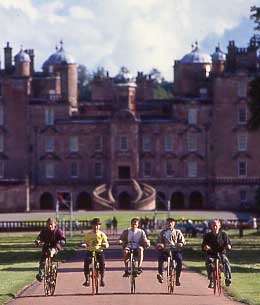
The site of the KM150 was Drumlanrig
Castle, a pink sandstone palace built in the 1680s and only about
an hour drive from the Glasgow airport. Here, the time-travel illusion
was complete: small roads with no cars, an amazing castle inhabited part-time
by the Duke of Buccleuch, stone buildings with thatched roofs at every
turn, rolling green fields with four-legged sweaters everywhere and about
140 other cyclists from around Europe dressed in vintage clothing and
riding antique bicycles.
First on the agenda was a two-day bus trip to Glasgow and Edinburgh where
we paraded through the downtowns while motorcycle cops blocked intersections
and led the way. Sitting high atop my bike I was almost eye-to-eye with
the double-decker bus drivers and I had a splendid view of the historic
cities. At the parade’s end, we received VIP treatment, lunching
with the mayor and enjoying a rousing bagpipe concert. In the afternoon
we toured museums and then met in a city park to demonstrate the vintage
cycles to the locals with various trick riding demonstrations and even
races.
Still wobbly on my big wheel, I didn’t race. It was enough of a challenge
riding in the stop-and-go parade with all the getting on and off (good
practice though). My big test was to be the century ride, a 100-mile tour
back at the castle in a couple of days.
Serious saddle time
 Completing
a century was a point of pride for cyclists a century ago and it remains
so today. Of course, today bicycles weigh about 20 pounds and may have
even more gears. The Victor weighs about 60 pounds and has one gear. It
was the original fixie.
Completing
a century was a point of pride for cyclists a century ago and it remains
so today. Of course, today bicycles weigh about 20 pounds and may have
even more gears. The Victor weighs about 60 pounds and has one gear. It
was the original fixie.
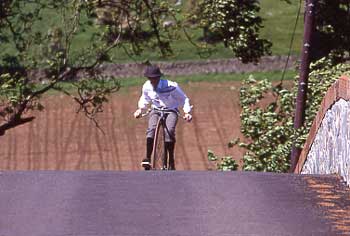
To get up
hills, I have to sprint toward them hoping I build enough momentum to
get over the top. If not, I have to get off and walk the hill. Then, if
the downhill is steep, I may have to get off again for safety. Because
the bike has a very rudimentary brake, if you build up too much speed
you can easily lose control.
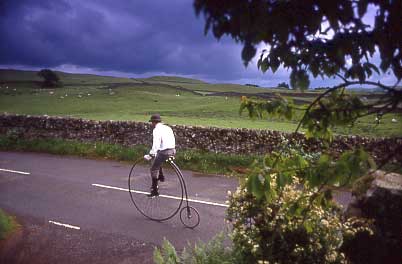
But there are great things about these
old bikes too. The pedals are attached to the wheel, so there’s
no chain or freewheeling sound. You roll along almost silently. Sitting
so high, there’s a splendid view; you can see over the stone walls
next to the road that block your sight on a regular bike. And the soft
seat and huge wheel cushion bumps better than suspension.
 In their day, the bikes were a huge technological advance over what was
available for personal transportation, namely, the horse. Lovely creature,
but it had to be fed, it couldn’t travel far or fast and it stunk
and attracted flies. No wonder highwheelers were considered status symbols
and people were willing to pay $100 for them (a king’s ransom at
the time).
In their day, the bikes were a huge technological advance over what was
available for personal transportation, namely, the horse. Lovely creature,
but it had to be fed, it couldn’t travel far or fast and it stunk
and attracted flies. No wonder highwheelers were considered status symbols
and people were willing to pay $100 for them (a king’s ransom at
the time).
Leading our century ride is bicycle historian, cycling book publisher
and father of a highwheel world champion, John
Pinkerton who coordinated the KM150. It’s obvious he’s a
skilled wheelman, riding no-handed and rolling down hills with his legs
draped over the handlebars.
Early in
the ride, he shouts, “Sleeping policeman.” And I can’t
for the life of me figure out what he’s talking about until I spot
a speed bump in the road. This represents a dangerous hazard when you’re
riding such a tip-prone bike and it tests my courage. I lean back and
pedal over the obstacle and make it, which builds my confidence tenfold.
Slow going
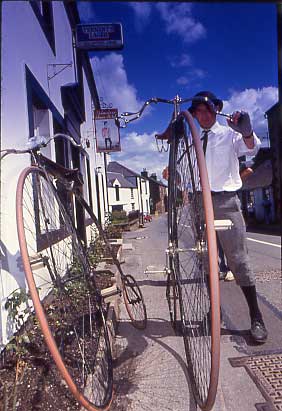 We’re
to ride three 30-mile loops plus a 10-mile loop. I find the going tough.
We modern humans are bigger than the people the bikes were made for and
it causes problems. My hands get numb because they’re too big for
the spade-handle grips on the bars. My feet are too wide for the pedals
so I have to pedal with my arches.
We’re
to ride three 30-mile loops plus a 10-mile loop. I find the going tough.
We modern humans are bigger than the people the bikes were made for and
it causes problems. My hands get numb because they’re too big for
the spade-handle grips on the bars. My feet are too wide for the pedals
so I have to pedal with my arches.
Worst of
all, I’ve made a mistake constructing the seat and a piece of metal
is jabbing me. Still, it’s the authenticity of the bike that makes
the experience so worthwhile; maybe like classical musicians who take
pride in playing only original instruments.
It takes me fifteen hours to complete the century, including about twenty
miles of wandering lost on roads off the course, a visit to a proper Scottish
pub (above) along the route to escape a rain shower, and a rest break
at a lovely overlook with a non-English-speaking Swiss rider who revives
me by sharing a hunk of ham, piece of bread and a Coke he’s carrying
in a canvas bag.
We ride
together to the finish though he’s far superior on a highwheel. At
the end, I’m so exhausted I fall asleep at the post-century banquet,
a first for me. But I feel great, more impressed than ever at the cyclists
a hundred years ago who rode these bikes every day on unpaved roads, and
feeling like I understand better than ever what cycling was like in the
old days.
At the Glasgow airport, I’m faced with another counter-person who
states, albeit with a heavy accent this time, “That giant bike box
is NOT going on the plane.”
 But
this time, perhaps steeled by my epic century ride, I simply reply, “Well,
I got it here, didn’t I?” He thinks about that for a minute,
smiles and says "You got me there, laddy." and checks me onto
the flight.
But
this time, perhaps steeled by my epic century ride, I simply reply, “Well,
I got it here, didn’t I?” He thinks about that for a minute,
smiles and says "You got me there, laddy." and checks me onto
the flight.
It feels
strange jetting back to the future after a glorious week in the past.
How to join the fun
The best
way to find out about antique cycling events is to join The
Wheelmen, a worldwide club of bicycle enthusiasts who get together
to relive the golden age of biking. Cost to join is $25 and for this you’ll
receive four newsletters a year alerting you to upcoming events and providing
classified ads from which you can purchase a bike. You’ll also receive
two magazines with articles about club members’ collections and various
bicycles and companies.
There are
many organizations and regional clubs around the world involved in the
vintage cycling hobby, too. The Wheelmen provide an extensive
list of links on their website I recommend checking. You’ll also
find some by searching under “antique bicycle” or “vintage
cycles.”
How to get your very own time machine
 It’s
fun to dream about discovering an original highwheel at a swap meet, antique
store or flea market, but it just doesn’t happen that often any more.
Most of the bikes have been found and are in the possession of collectors.
It’s
fun to dream about discovering an original highwheel at a swap meet, antique
store or flea market, but it just doesn’t happen that often any more.
Most of the bikes have been found and are in the possession of collectors.
So, the
easiest way to pick up a vintage highwheel is to find
a collector who has one for sale. Expect to pay from $2,000 to $4,000
for an original bike—or more if it’s in excellent condition.
And do your research
before buying so you don’t pay through the nose for a basket case.
Or, consider
purchasing a reproduction highwheel built to the same standards as the
originals. One source is Mesicek.
These highwheels can be ordered through bicycle shops. Or contact Victory
Bicycles. Or, if you're interested in modern highweels, try Rideable
Replicas or Rocky
Mountain Highwheels.
Feedback
on this article
Jim — At the
bottom of your article you had previously mentioned the repro makers,
Edlee and Kennedy. I would like to let you know that Kennedy is not making
bikes anymore. I had a couple of his which were pretty nice (a 53 inch
and 54 inch). I rode the 54 inch many places (Argus Ride around the Cape
in Capetown, South Africa; in the Krueger game preserve; around Seoul,
Korea; in Tasmania, Australia; in South Island NZ; from Edinburgh Scotland
to Harlem in the Netherlands; from Amsterdam to Wiesbaden; and around
in the US. However, Lowell Kennedy passed away a few years ago. His wife
Teresa is still making accessories.
Edlee has stopped making bikes also. He will do the odd one now, since
his attempt to sell the business failed. He has bad back problems, however,
which slowed him down a lot. He has another business (a gallery) which
takes most of his time. I have a 55 inch rational which he made (ser #
25) and I have ridden it on 4 of my 7 Tasmania trips and on 3 of the 5
New Zealand trips. It is light and fast even though it was made as heavy
duty as he ever made one (80-count 12-gauge spokes instead of his usual
64- or 72-count 14-gauge — and an integral I beam in the backbone
for the top 16 inches where the vertical forces of the saddle spring are
perpendicular to the backbone).
I also have a 58 inch Racing Edlee which has 14G bladed spokes as well
as 5/8 rubber and is called XCLR8 with "Stealth" on the upper backbone.
This bike won the Aussie championship with a 49-year-old on it beating
all the 25- to 35-year-olds. It has a saddle tight to the backbone. Both
of these bikes are for sale in case anyone wants one ($2,500 each firm
— I paid 5,200 Aussie for the 55 inch).
The best repro maker is now Victory bikes in Florida (making the Spillane
"Whitney" copy of the 1885 Victor since Jim Spillane Jr. stopped building
them after his wife died). The Florida makers changed the name from Whitney
to Victory and made a few improvements. It is still an 1885 Victor copy,
however. It still has the same saddle design as Whitney — a bad copy
of the 1888 Brooks International Long Distance saddle (great copies of
this fine saddle are available elsewhere). I do not know why they did
not copy the Victor Swing Saddle.
The Mesicek bike has some problems in the head. The hardened bottom cups
do come loose easily. This makes for a floppy ride! I have also seen one
with the rear fork and wheel fall off. I have also seen the front wheel
implode without cause. I know the makers and the US importer. They are
nice folks but I cannot recommend the bike.
There is a good copy of the Rudge being made in Cz Republic now —
evening and weekends — small quantities. Martin Cvrcek (sp?) is making
them.
Then there is a guy (Bob) trying to start making Rudge copies in Viet
Nam. I was consulting to him, answering his email questions and plans
for review — to make him not do stupid things until he finally totally
pissed me off. I fear he will make an abortion even though I told him
where there was an original Rudge in Singapore. I had bought it at Copake
bike auction for an old friend who is now working there. Bob has borrowed
and disassembled it but I do not believe he understands metal and stresses.
So with a whole top quality bike in front of him, I think he can still
really mess up.
I would not recommend repros, however. Original Ordinaries (like your
56 inch 1886 Victor) are the best plan. They can be found! Of course,
it needs a good restoration unless you are very lucky and get a well preserved
one. I always recommend the best quality bikes (tangent spokes generally).
Here's a short comparison
of some of the better makes and models:
I have an 1885 56 inch
Victor and 3 1886 54 inch Victor.
Interestingly, the 3 1886 54 inch Victors all ride differently and all
ride well. They feel far lighter than the 56 inch. I have ridden other
56 inch Victors and all seem heavy like you described. One of my 54 inches
is really light riding. One is medium. One is medium heavy, not as heavy
as the 56, however. They are all the same size and year, and restored.
I also have a 48 inch, 50 inch, and 52 inch Victors. The 48 inch and 52
inch are not yet restored. Thus not ridden to assess how they ride. They
are from 1888 and 1890, late models. The 50 inch is a good medium weight
1885 (first year).
I generally ride Rudges now.
They are really nice (the tangent "Light Roadster" models anyway). I have
a 50 inch Light Roadster, Racing 52 inch; Light Roadster 52 inch, 2 Light
Roadster 54 inches, 2 Light Roadster 55 inch's, a 58 inch Light Roadster,
and a 60 inch Light Roadster. I love the 54s and 55s. Interestingly the
55s are both lighter than the 54s. They are great for a fast local run
but would not suit for a transcontinental. The 58 inch and 60 inch are
in restoration now in England and Europe. My 6-foot 7-inch son-in-law
is currently squeezed into the 56 inch heavy Victor. He will get to use
the 58 inch and 60 inch Rudges when they are back, and see how he likes
a bigger (but light and fast) machine.
Columbia Light Roadsters are good also.
I have a 55 inch and a 57 inch. I like the 55 inch as a medium light bike
with a solid ride. The 57 inch seems really light and a bit more mobile
(wimpy) in the backbone. They don't feel like Experts or Victors, at all.
They are more like Edlee in feel. The Expert is a lot like the 56 inch
Victor for feel. The 1885 Victor was made to compete with the Expert which
dominated the market and to be more competitive by incorporating updated
construction standards (hollow bars, tangent spokes, hollow rims... which
were on Brit bikes but not in the US). The Columbia Light Roadster was
Columbia's answer to the competition from Victor. Actually, Victors were
not made by Overman Wheel Company the first couple of years. They were
made for them by Adams, I believe. Overman Wheel Company built a factory
in the later 1880s and started making their own bikes at that time. They
were initially a design and marketing firm. This is not unlike current
trends in US corporate outsourcing.
The most responsive bikes I have ridden are G&J American Light Champion
(7-cross tangent with curved bars back) and Regent (uniquely fine radial
spoked machine from 1891). Other great bikes are the New Rapids, 7-cross
tangent English bikes with massive look tubes and light weight (think
of the Cannondale Aluminum bikes of the 1980s...but refined). My 52 inch
has 34-inch-wide bars. I have ridden 54 and 56 inch New Rapids which are
also fantastic.
To summarize, there are great originals out there. They are better values
than repros. They are AAA investments you can ride. If I can find all
of these great bikes without being in the US half of the time, then anyone
can find a good rider for him/herself if he wants to. Last spring a new
lady Wheelman wanted a bike and I pointed her to a 50 inch New Rapid with
original all-nickel frame. She now has a bike which can ride her around
the world with low chance of mechanical issue. It cost less (even after
all of the little fix ups I helped with) than a new Victory from Florida.
Her bike will appreciate. A repro will depreciate. When asked, she can
say it was made in 1887. A repro owner can say 2002 or 1997 or 2004. It
feels better to say 1887 — a lot better.
If you are ever out in the Denver Area, feel free to call and stop by.
You might enjoy seeing a few things. I also have an 1880s and 1890s cycling
library with 46,000 pages of pre-1900 bike magazines, and lots of books.
Cheers,
Steve Stevens,
March 2004
Golden Oldy Cyclery
1-303-271-1998