|

|
|
One of the most engaging people I met while working at The
Bicycle Center in Santa Cruz, California, was Laurence
Malone. A five-time national cyclocross
champion and veteran of the Coors Classic and numerous other big-time
bicycle road races, he’s also a gifted writer and story-teller. My favorite yarn he told me had to do with bicycle tubular tires (also called “sew-ups” or “tubs”). Laurence was on a US team competing in a stage race in South America where the roads are sometimes hardpacked dirt with ravines on the sides. During one mountainous stage Laurence came hurtling down a hill, banked hard into a corner and rolled both tubulars off the rims. Now, Malone is such a talented bicycle handler that he created a sensation in European cross events by bunny-hopping the 18-inch-tall barriers, something unheard of previously. For this feat, the Euros dubbed him the American Kangaroo. But even leaping Laurence couldn’t remain upright when those tubs let loose. He fell onto his side and shot sideways toward the road’s edge and a cliff-like dropoff. Luckily, he stopped just in time to avoid the plunge and certain disaster. Naturally, he managed to get going again and finish the stage anyway. At the race’s end he turned his mount over to team mechanic Bill Woodul (now in the US Bicycling Hall of Fame), who quite understandably, was mortified to hear what had happened. Thinking that it’s all just in a day’s work, Laurence was surprised by Woodul retort: “Laurence, there ain’t no way those tires would’ve rolled had I glued ’em on right in the first place!” There are lessons to be learned from this story. First: Bill Woodul was a stand-up guy for taking the blame. And two—what we’re concerned with here—tubular tires don’t always stay put. In fact, even in the Tour de France, the most important professional event, sew-ups roll. Which tells you that there’s a darn good chance that even if you do everything right, in an extreme-enough situation, such as bombing down an alpine pass, the sew-ups may still come off. Your best chance of prevention is to follow a careful tubular installation procedure. Here’s what I recommend: What You’ll Need:
1. Stretching tires. Installing new tires is easiest if you stretch them first. A handy way to do this is to keep some used rims or wheels around to be used as stretchers. By storing new tires on rims, the treads will be ready when it’s time to install new rubber on your good wheels and you won’t have to wait for the new ones to stretch on your main rims. New tubs can be tough to put on rims. Some folks recommend hanging the tubular over one shoulder and putting
a knee through the bottom loop of the tire and then straightening your
back as you push with your knee to stretch the tire (don’t overdo
it or you may damage the tire). I prefer to grip the tire with my hands
about a foot apart and pull to stretch that section. Then I repeat this
around the entire sew-up. Either approach will make it easier to slip
a new tire on a rim. If you have trouble getting the new tire on the
rim, use the technique described in step 7. If your rim is caked with old glue you can chip it off with a scraper
tool but it'll take a little time and focus. You can also chemically
strip the glue but then be sure to get all the stripper off or else
it may prevent the tire from adhering to the rim. You may want to give the tire base tape a little roughing up with emery
cloth too, if it seems too smooth. Then place your finger in a baggie and rest your finger on the rim
while slowly turning the wheel. With a little practice you’ll get
the feel for smearing the glue just right to leave an even coat that
reaches from rim edge to rim edge. Wait about 30 minutes for the first
coat to set up and apply a second coat of glue. Push the point of an
old pencil in the valve hole to clean out any glue that’s there. Lay the tire over the top and front of the wheel and start installation by placing the valve stem into the valve hole. Now, simultaneously, push downward against the floor while gradually lifting and placing the tire on the rim as you work your hands away from each other and toward the floor. Put considerable downward pressure on the tire/wheel. The glue will act as a lubricant helping the tire stretch slightly as you push downward. As your hands nearly reach the floor, push them toward each other with
as much muscle as you can muster. Then lift the wheel and pop on the
last section of the tire. If you’ve pushed down hard enough and
followed this procedure correctly, there should be sufficient clearance
and the tire will be easy to pop on the rim. Best, there’ll be
no glue on the tire or rim sidewalls, because it is not easy to clean
off. For the latter, sight the bottom of the spinning tire and check that the same amount of base tape shows on both sides. Correct imperfections by twisting the tire at the areas that need alignment. Another method is to roll the tire on the ground while pressing down on the wheel with your body weight, which sometimes centers the tire with no further effort. When it's seated as perfectly as possible, let the tire sit for 24 hours before riding on it so the glue can dry. More tips: Many sew-ups use removable valve cores (look for wrench flats near the tip of the valve), a nice feature because they can be replaced if they get damaged. If yours has the flats, it’s a good idea to check the tightness of the valve by turning clockwise with a small adjustable wrench. You may just prevent a slow leak. For tall-profile aero rims (like so many of the carbon
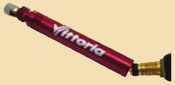
tubular rims), be sure to get valve extender adapters
and install them on your new tubular tires before mounting
the tires on the rims. That way you can test fit the tires and make
sure the extenders reach far enough through the rims. Also, the extenders
give you something to watch as you install the tires to make sure the
valves are being installed straight, not crooked. And, you can inflate
the tires and make sure the adapters work, too. Vittoria
now makes a series of sew-up tires featuring interchangeable removable
valves so you can switch out to their longer length if you need them
and don’t mind paying a lot for 2 long valves after you’ve
already shelled out a bundle for your new tires that accept the valves.
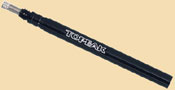
Or, just go with Topeak’s,
which fit all valves—even standard tube valves, and that feature
O-rings for an airtight seal. They’re the best extenders I’ve
used.
 to the WRENCH page |
||
Preparing and Folding the SpareIf you’re new to tubular tires,
don’t make the beginners’ mistake of carrying a spare tire
and a tube of glue, planning to glue your spare tire onto your wheel
on the side of the road when you puncture. The time to glue the spare
is at home, before you do your favorite loop. When you have a selection
of used tires, carry one of those because it’ll already have a
coat of glue on it. Old cement, even if it appears dry, will bond with
the leftover glue on the rim securing the tire and you’ll be back
in the saddle in no time. With a new tire, follow step 6 to prepare it for use as a spare but let the glue dry overnight. Then fold the tubular into a neat bundle for storage beneath the seat or in a bag. For a clean job, open the valve stem and start by holding the tire in two places and pulling it taut so that there are two folds with the valve stem at one. Holding it like this, lay it on a bench and ensure that the basetape is facing up. Carefully, roll the tire over on itself pushing out any air as you go. With a few tries, you’ll roll it up into a neat bundle with symmetrical overlaps. It’ll look so professional, you may decide to simply wrap it in the sports page of the Sunday paper and toe-strap it beneath your seat rather than stuffing it in a sock or bag. That way, your riding chums can admire your handiwork. |
|||
|
|
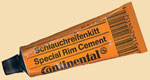 ones; my current favorite is Continental)