Please
note:
This article is about removing and installing bicycle pedals. If you’re
looking for information on installing cleats for clipless pedal shoe
systems like Look, Shimano, Speedplay, Time, etc., go here
Required
tools:
There are special pedal wrenches available that are long for optimum
leverage and have thin jaws to fit onto narrow pedal axles for a good
purchase (Park Tool's
pedal wrench, which I use and recommend is shown in the picture
on the bottom of this page).
Depending
on what type of pedals you have, you might be able to use a regular
combination wrench instead (most pedals are 15mm). Note that some pedals
are installed and removed with an Allen wrench inserted into the end
of the threaded end of the pedal axle. You’ll need one with a long
handle like this.
Or, you can slip a piece of tubing or pipe over a regular Allen to lengthen
your wrench and improve the leverage you have.
The
most common reason to remove pedals is to upgrade or to switch a pair
from one bike to another. You usually must remove the pedals when you
ship your bicycle in a bike
box, too.
Pedal
removal and installation is trickier than it looks.
Because pedal axles are usually made of steel and crankarms are usually
aluminum, there’s the possibility of the hard pedal threads stripping
the soft aluminum ones during pedal installation.
Also, pedal threading is unusual and confusing. The right (drivetrain
side) pedal has regular threading (clockwise turns tighten it; counterclockwise
turns loosen it). The left, however, is the opposite. What’s more,
pedals are often attached to the crankarms super tightly, which can
make removal quite difficult.
It
was the "father of the bicycle," James Starley who invented
the reverse-threaded left pedal. Until this innovation, left pedals
would unscrew and fall off. Their reverse threading fixed the problem.
Here’s my video on pedals. Click to watch the show full size on YouTube.
Removal:
Most pedals have flat spots on the axle near the crankarm for the wrench
to grip. If you don’t see any flats, your pedal probably requires
an Allen wrench, in which case, the hole for the tool will be in the
end of the pedal axle, on the inside of the crankarm.
Safety
tip: If your bike has more than one chainring, before trying to
loosen pedals, shift onto the large chainring. This ensures that if
you slip when working on the pedals, as I’ve seen happen to a
few mechanics, you won’t slam your hand or wrist directly into
the chainring teeth, which results in a nasty injury since the teeth
are typically extremely sharp and also quite greasy.
There
are 3 “secrets” to easy pedal removal: 1. Turn the wrench the right way (to loosen
the right and left pedal, the wrench is turned towards the back of the
bike). Note that if you turn it the wrong way first you can make it
even harder to remove the pedals because you tightened them even more
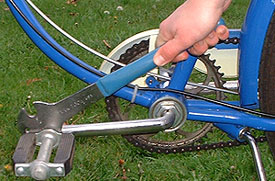
first! 2.Position the wrench alongside the crankarm
for optimum leverage. When it’s right, you’ll be able to push
toward the crankarm, scissors style (photo right). If this isn’t
possible with your wrench, try a different type. 3.Use a pedal wrench with a long handle or
attach a “cheater” bar, such as a length of pipe, over your
wrench.
How to deal with stuck or frozen pedals
If you try all these steps and simply can’t get the pedals off,
here are some ways to extract even the stubbornist of pedals: 1. Use a penetrant like Liquid Wrench. If you have
the time to wait for it to work, apply Liquid Wrench to the pedal threads.
Given time to work its magic, it should penetrate its way between the
threads making the pedals removable. Or try Finish
Line's Chill Zone, which freezes and penetrates. 2. Use heat. Try heating the crankarm with a propane
torch. Heat only the crankarm, not the pedal, which likely has plastic
or rubber seals or parts that the heat will damage. Heating the crankarm
a bit will expand it slightly (especially aluminum crankarms) and should
loosen the pedal. Be careful NOT to touch the hot crankarm and burn
yourself and it doesn't take much to heat up an aluminum crankarm so
don't heat it too long! 3.Use a vise. If you have a sturdy
bench vise, remove the crankarm(s) with the stuck pedal in it. Place
the crankarm in the vise with the pedal facing up and positioned so
you can get your pedal wrench on the axle flats (use soft vise jaws
or wood blocks to protect nice crankarms). With the vise holding the
pedal, all your force will be directed into the axle and greatly increase
the chance that you can remove the pedal. 4. Use an oversize monkey wrench (also called a pipe wrench).
If you're dealing with old-style rubber pedals like the ones shown in
the picture of the blue cruiser bike above, and the pedals are old and
worn out, you can bend and twist and break the bodies off. This will
leave only the pedal axles attached to the crankarm. And, if you have
a large monkey wrench
you’ll be able to grab the axles with enough purchase to turn
them and remove the pedals (the more you tug on a monkey wrench the
tighter it grips what you’re trying to turn). Using this technique
I once removed a pedal someone had welding into a crankarm!
Installation:
One of the reasons pedals can be difficult to remove is lack of lubrication.
So, be sure to grease the pedal threads before installation.
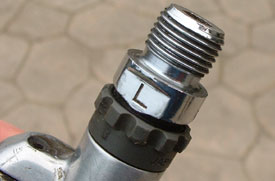
Then look closely at the pedal axles or ends to see which side they
belong on. You should see a little “R” and “L,”
(photo below) for “Right” and “Left.” Note
that French pedals sometimes have “D” and “G” for
“Droit” and “Gauche.”
Choose the appropriate pedal and start it into the correct crankarm
by hand turning the pedal axle toward the front of the bike (both pedals
thread in in this direction). If it won’t start, don’t force
it! You’re probably trying to install the left pedal on the right
side or vice versa.
Take your time and resist the temptation to force the pedals in. The
pedals have steel threads and the crankarms are usually aluminum. It’s
very easy to ruin the crankarm threads by forcing the wrong-side pedal
in. So, don’t force it. Crankarms are expensive!
Thread
both pedals into the crankarms as far as you can by hand. Then fully
tighten them with the pedal wrench. It’s important to get pedals
good and snug so they can’t loosen from pedal pressure (a loose
pedal can make a click or tick that drives
you nuts and is hard to find). Tightening sufficiently can be difficult
with pedals requiring an Allen wrench if you only have a short tool.
For these, use a cheater bar to ensure adequate tightness.